

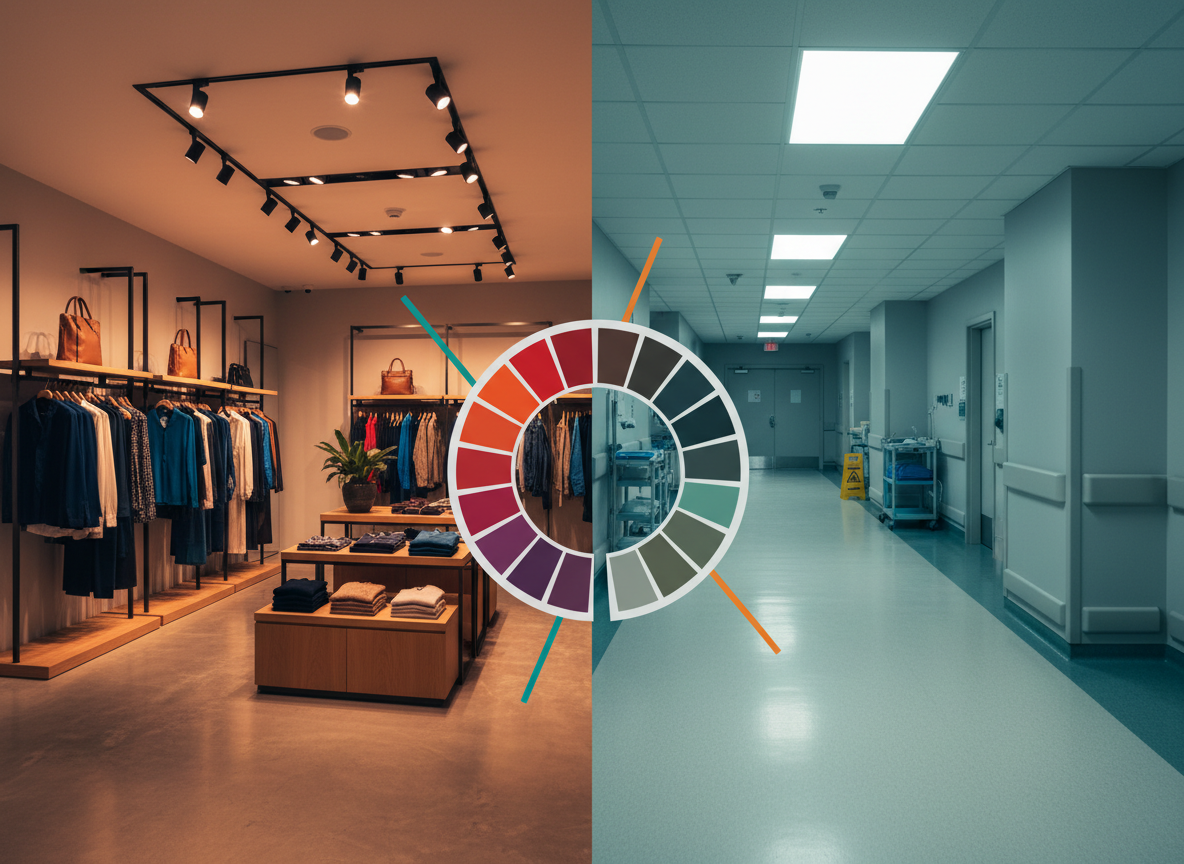

If you've ever stood in a freshly commissioned space and thought the lighting looked technically correct but somehow off — food appearing flat, skin tones looking washed out, merchandise failing to pop — you've encountered the limits of CRI as a specification tool. The number was right. The room was not.
This post is for the people who read submittals, walk job sites, and argue with distributors over fixture substitutions. We're going to cover what CRI actually measures, why TM-30 was developed to address its shortcomings, and where each metric should drive your decisions. No color science PhD required.
What Is CRI — and Where Does It Fall Short?
The Color Rendering Index has been the dominant metric for light source color quality since it was standardized by the International Commission on Illumination (CIE) in 1965 and refined in 1974. The concept is straightforward: compare how a test light source renders a set of reference color samples against how a reference illuminant (typically blackbody radiation or daylight) renders the same samples. Average the results. Report a single number from 0 to 100.
That single number — Ra, or general CRI — is what ends up on every spec sheet and submittal. An LED troffer rated CRI 80 and one rated CRI 90 are immediately comparable in a way that matters for spec work.
The problems are real, though, and they compound the higher the stakes of the project:
- The sample set is limited and dated. CRI Ra is calculated from eight pastel color samples (R1–R8), selected in the 1960s. Saturated colors — deep reds, vivid greens, bright blues — are not adequately represented.
- R9 is not included in Ra. R9 measures red saturation — the most consequential sample for skin tones, meat and produce, red emergency signage, and arterial blood in surgical environments. A fixture can achieve CRI 90 with an R9 value below zero and still make warm skin tones look sallow.
- The averaging problem. Because Ra is an average, a source that renders some colors beautifully and murders others can score identically to one that renders everything moderately well. You can't tell them apart from the spec sheet.
- CRI only measures fidelity. It says nothing about whether the light source makes colors appear more vivid or appealing than the reference — a characteristic some applications actively want.
What Is TM-30?
TM-30 is a color rendition measurement method developed by the Illuminating Engineering Society (IES) and first published in 2015, with significant updates in 2018 (TM-30-18) and 2020 (TM-30-20). It was built from the ground up to address CRI's structural weaknesses, using modern color science and a sample set that reflects how people actually encounter color.
Where CRI uses 8 samples, TM-30 uses 99 color evaluation samples drawn from real objects — human skin, food, foliage, textiles, painted surfaces, and manufactured objects — covering the full range of hue and chroma that specifiers actually care about.
TM-30 produces two primary metrics:
Rf — Fidelity Index
The TM-30 equivalent of CRI. Measures how accurately a light source renders colors compared to a reference illuminant on a 0–100 scale. Think of Rf as the updated, better-calibrated version of the number you already use — but note that the underlying math is different enough that Rf and CRI are not directly interchangeable.
Rg — Gamut Index
The metric CRI completely lacks. Rg measures the average saturation or vividness of colors under the test source compared to the reference. The scale is centered on 100. An Rg above 100 means the light source makes colors appear more vivid and saturated — often desirable in retail, food service, and hospitality. An Rg below 100 means colors appear duller and more muted.
TM-30 also produces a full graphical output called the Color Vector Graphic, which shows how individual hue-chroma regions are shifted or distorted. For most commercial spec work, Rf and Rg together give you enough information to make a good decision. The Color Vector Graphic is the tool for truly critical applications — surgical suites, museum conservation, luxury retail — where the directionality of color shifts matters.
TM-30 vs. CRI: Side-by-Side Comparison
| Attribute | CRI (Ra) | TM-30 |
|---|---|---|
| Developed by | CIE (1974) | IES (2015, updated 2018/2020) |
| Color samples | 8 pastel samples (R1–R8) | 99 real-world objects, full chroma range |
| Metrics produced | Single number (Ra), optional R9 | Rf (fidelity) + Rg (gamut) + Color Vector Graphic |
| Measures fidelity | Yes | Yes (Rf) |
| Measures vividness/saturation | No | Yes (Rg) |
| Red saturation | Separate R9, often omitted | Incorporated in the 99-sample set |
| Distinguishes similar-scoring sources | Poor — averaging masks differences | Better — two metrics reveal trade-offs |
| In energy codes | Yes — ASHRAE 90.1, IECC, Title 24 | Not yet in most codes |
| Manufacturer reporting | Universal | Growing — not yet universal |
| Learning curve | Low | Moderate |
Real-World Application by Space Type
Retail
Retail is where TM-30's Rg metric earns its keep. A light source with Rg 105–110 makes merchandise appear more saturated and appealing — clothing looks richer, jewelry more brilliant, produce fresher. Fashion retailers have been chasing this effect for years with high-CRI sources, but Rg lets you specify it directly rather than hoping CRI approximates it.
Healthcare
Healthcare is where R9 — and TM-30's fuller treatment of red saturation — matters most. Skin tone assessment, wound evaluation, blood color in surgical settings all depend on accurate red rendering. A CRI 90+ spec with minimum R9 of 50 has been the clinical convention, and it's still defensible. TM-30 Rf 85+ with attention to the skin-tone hue regions of the Color Vector Graphic is the better specification for critical care, surgical, and diagnostic spaces.
Museums and Galleries
Conservation-grade lighting is the application where the full Color Vector Graphic earns its complexity cost. Museums need to know not just how accurate colors appear, but which directions they are shifted — a cyan that shifts toward green versus blue has different implications for a particular painting. Progressive specifications here are beginning to drop CRI entirely in favor of TM-30.
Offices
For standard open-plan office environments, CRI 80 remains the workhorse specification and is adequate for general task performance. For executive spaces, design-forward interiors, or applications where material and finishes rendition matters to the owner, CRI 90+ or TM-30 Rf 85+ is appropriate.
Industry Adoption of TM-30 Today: An Honest Assessment
TM-30 is not in the energy codes. ASHRAE 90.1, IECC, and Title 24 still reference CRI. If your project is spec'd to an energy code, CRI is what matters for compliance documentation.
Some forward-thinking specifications — particularly from larger design firms, federal agencies, and museum clients — are beginning to include TM-30 requirements alongside or instead of CRI. This is still the exception rather than the rule.
Manufacturer adoption is uneven. Larger LED manufacturers who target the premium commercial market are increasingly reporting TM-30 metrics on data sheets. Smaller manufacturers and commodity product lines often still report only CRI. If your spec requires TM-30 data and a proposed substitution's manufacturer doesn't provide it, your ability to enforce the requirement depends on whether you can compel them to test it.
The trajectory is clearly toward broader TM-30 adoption — the IES has been actively promoting the method, major specification platforms have integrated TM-30 reporting, and the Lighting Facts label program has added TM-30 fields. But as of 2026, a commercial specifier who writes TM-30-only requirements without a CRI fallback is going to encounter friction in procurement.
The practical approach right now:
Use CRI as the baseline code-compliance metric. Add TM-30 requirements where the application justifies the precision. Require both metrics from manufacturers when TM-30 is specified.
5 Actionable Recommendations for Specifiers
- 1
Always specify R9 alongside Ra.
Until TM-30 is universal, the single highest-impact improvement to a CRI-based specification is requiring a minimum R9. For general commercial, a minimum R9 of 20 adds meaningful red saturation protection. For healthcare, food service, and hospitality, a minimum R9 of 50 should be the floor.
- 2
Adopt TM-30 reporting requirements in your submittal process.
Even if you're not yet writing TM-30 minimums into specifications, start requiring manufacturers to provide Rf and Rg data alongside CRI on submittals. This costs you nothing and builds a data set that lets you make better decisions over time.
- 3
Match the metric to the stakes of the application.
CRI 80 is fine for a parking garage or back-of-house storage. TM-30 Rf 85+ and Rg 100+ is worth specifying for a restaurant dining room, retail floor, or hospitality lobby where the owner's business depends on how their space looks.
- 4
Treat Rg as a design tool, not just a quality threshold.
An Rg slightly above 100 (say, 102–107) creates a perceived vibrancy that owners of high-end retail, food service, and hospitality spaces will notice positively. Communicate this to clients when reviewing fixture options.
- 5
Require both metrics during substitution review.
Substitution requests are where specification intent most often gets eroded. A fixture that meets CRI 90 may have an Rg of 93 that makes the finished space look flat compared to what you originally specified. Build TM-30 data requirements into your substitution review process now.
FAQ
Can I use TM-30 Rf as a direct substitute for CRI in a code-compliant specification?
Not yet, in most jurisdictions. Energy codes that reference color rendering requirements — including ASHRAE 90.1 and IECC — specify CRI (Ra). Until those codes are updated to reference TM-30, you need CRI for compliance documentation. TM-30 requirements can be layered on top as additional specification criteria.
A fixture has CRI 90 but the manufacturer doesn't report TM-30. How do I evaluate it?
Request R9 data at minimum — any competent manufacturer can provide this. If the manufacturer cannot or will not provide R9 and TM-30 data, that's information in itself. For critical applications, it may be reason enough to look at alternatives whose manufacturers are more transparent about their performance data.
What TM-30 values should I specify for a high-end retail or hospitality project?
A starting point for premium commercial applications: Rf 85+ and Rg 100–110. The upper bound on Rg matters — sources with Rg above 115 can make colors appear garish. For most applications, Rg in the 100–110 range produces the 'everything looks great' effect without tipping into caricature.
The fixture that tested well in the mockup looks different in the final installation. Could this be a TM-30 issue?
Possibly. If the mockup used a different light source than the final installation — or even a different batch from the same manufacturer — color rendering can shift. TM-30 gives you a more complete picture of what changed and why. Ask the manufacturer for TM-30 data for both sources and compare the Color Vector Graphics side by side.
Is TM-30 relevant for controls specifications, or is it purely a fixture selection tool?
TM-30 is primarily a light source metric evaluated at the fixture level. That said, controls decisions that affect delivered light levels — dimming curves, setpoints, daylight harvesting offsets — can interact with how color rendering is perceived, because many LED sources shift slightly in color as they dim. If accurate color rendering is critical on a project, it's worth confirming with the manufacturer how their product's TM-30 performance holds across the intended dimming range.
Color rendering is one of those topics where the gap between what gets specified and what the end user actually experiences is wide enough to drive a truck through. CRI got us most of the way for decades, and it's not going away. But TM-30 gives specifiers a more complete vocabulary for what they're actually trying to achieve — and the more fluent you get with it now, the better positioned you'll be when the codes catch up.
Working through submittals on a current project?
If you want a second set of eyes on the color rendering specifications, or if you're building a specification template that integrates TM-30 requirements properly, get in touch. We work with designers, electrical engineers, and contractors across the country on exactly these kinds of decisions.
Contact Wilco Services