

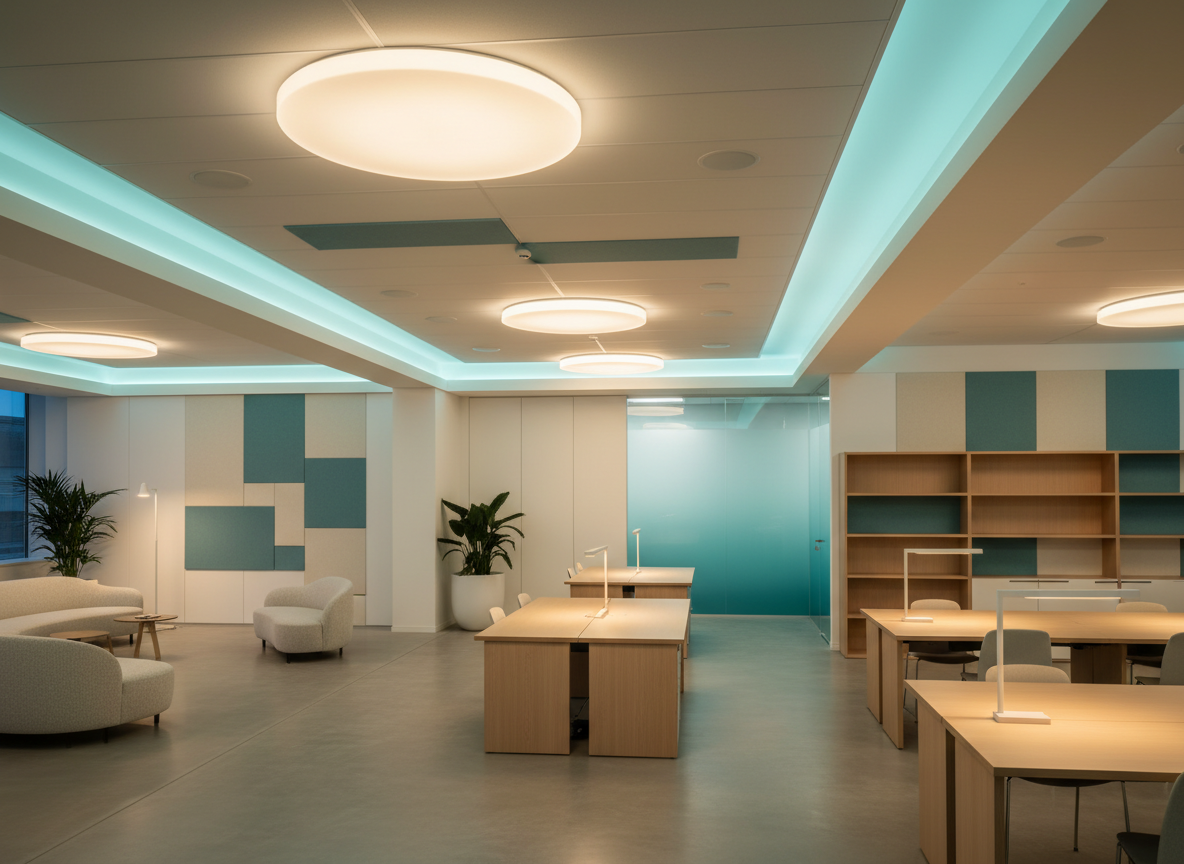

I've spent nearly 20 years programming and commissioning lighting control systems across the country. I've worked in hospitals, schools, airports, arenas, and office buildings. And in every single one of those spaces, I've thought about the same thing: how does this light feel to the people inside it?
That question isn't just professional for me. It's personal. I'm Autistic, and lighting controls is my special interest. I don't just work in this field — I live it. And because of that, I understand something that doesn't always make it into the spec sheet: lighting isn't just about illumination. It's about how people experience a space.
Nearly 1 in 5 People Are Neurodivergent
Neurodiversity encompasses conditions like autism, ADHD, dyslexia, and dyspraxia. People who are neurodivergent process sensory information differently — and for many, poorly designed lighting isn't just uncomfortable. It can cause genuine distress, reduce productivity, and make a space feel completely unusable.
Flickering fluorescents. Harsh overhead glare. Abrupt transitions between bright and dim zones. These aren't minor annoyances for neurodivergent occupants — they're barriers.
The good news? Lighting controls are the solution. And they're more capable than most people realize.
PAS 6463: A Standard Worth Knowing
In 2022, the British Standards Institution published PAS 6463 — “Design for the Mind: Neurodiversity and the Built Environment.” It's a landmark framework that gives architects and designers concrete guidance for creating spaces that accommodate neurological differences.
While it's a UK standard, it's gaining serious international attention — and it should be on every lighting designer's radar in the US.
“Good lighting is crucial in allowing people with sensory and neurological processing differences to use buildings conveniently and safely.”
PAS 6463 — British Standards Institution, 2022
That's not a suggestion. That's a design imperative.
What Inclusive Lighting Actually Looks Like
Here's where the controls piece becomes critical. Inclusive lighting design isn't about picking the “right” fixture — it's about programmability, flexibility, and personal control.
Color Temperature Matters More Than You Think
Warmer color temperatures (2700–3000K) have a calming effect and work well in shared spaces, break rooms, and collaborative areas. Cooler temperatures (3500–4000K) support focus and are better suited for task-oriented environments. A well-programmed system can deliver the right CCT in the right zone — automatically.
Glare Is Not Optional to Address
For neurodivergent occupants, high contrast between bright and dark zones can be disorienting and overwhelming. Diffuse fixtures, careful zoning, and dimming control help balance light levels across a space and reduce that jarring contrast.
Personal Override Is a Necessity, Not a Luxury
The most sophisticated lighting systems balance automation with individual control. A neurodivergent employee shouldn't have to fight a rigid automated system to get comfortable. The best implementations give occupants the ability to adjust brightness and color temperature based on their moment-to-moment sensory needs — while still maintaining energy code compliance.
BMS Integration Amplifies Everything
When lighting controls are integrated with a building management system, facility managers gain centralized oversight and continuous optimization. But critically, that integration doesn't have to eliminate personal control. Done right, it enhances it — creating smarter buildings that serve every occupant.
Why This Matters to Me — and to Wilco Services
I didn't choose lighting controls because it was a good career move. I chose it because I genuinely love it. And part of that love is knowing that a well-executed lighting control system can make a real difference in someone's daily experience of a building.
When lighting goes unnoticed, that means it's working. For a neurodivergent person who has spent years being overwhelmed by poorly designed spaces, that invisibility is everything.
If you're designing, building, or managing a space and want to talk through how lighting controls can support inclusive design — I'd love that conversation.
Let's build spaces that work for everyone.
Want to talk inclusive lighting design?
Whether you're designing a new space or retrofitting an existing system, we can help you build a lighting control solution that works for every occupant.
Get In Touch